
Shawnee City Directory Collections
The strongest documented Shawnee city directory leads are held through the Oklahoma Historical Society, its Research Center catalogs, and partner collections. The National Park Service asset cited in the research identifies a Star Directory Company volume dated September 1, 1901, then a long group of Polk's Shawnee references. Those citations are a reliable starting point, but they do not mean every volume is scanned or ready on an open shelf. Use the Oklahoma Historical Society city-directory search to identify a city and year, then ask the Research Center or a participating library to confirm the volume and page.
| Collection | Years | Where held | Access route |
|---|---|---|---|
| Star Directory Company, Shawnee City Directory | September 1, 1901 | OHS bibliographic lead | Request the volume and page; a classified section is cited at page 95. |
| Polk's Shawnee directories | 1909, 1912, 1914, 1916, 1919, 1923, 1925, 1928, 1930, 1931, 1935, 1937, 1939, 1941, 1946, 1949, 1952; later 1988 and 1992-95 references | OHS and partner catalogs | Confirm shelf or digital availability for the exact year. |
| Shawnee News-Star | Title 1943-current; visible digital run includes 1957-1962 | OHS Gateway and library microfilm | Search issue pages, then check the image against OCR. |
| Telephone books, yearbooks, and family histories | Exact Shawnee runs need confirmation | OHS Research Center, Shawnee Public Library, and FamilySearch routes | Ask for a title, school, date, or surname rather than assuming a complete run. |
City directories are best read as annual or near-annual snapshots. A missing year can reflect a gap in a collection, a publisher change, or an unlisted person. It is not a finding that a household was absent. Keep the printed year, the volume source, and the page citation with every entry.
The Oklahoma Historical Society Research Center collections are the first catalog stop for directories, telephone books, yearbooks, maps, photographs, newspapers, and family histories. The collection screen below is useful for choosing the right format before arranging access.
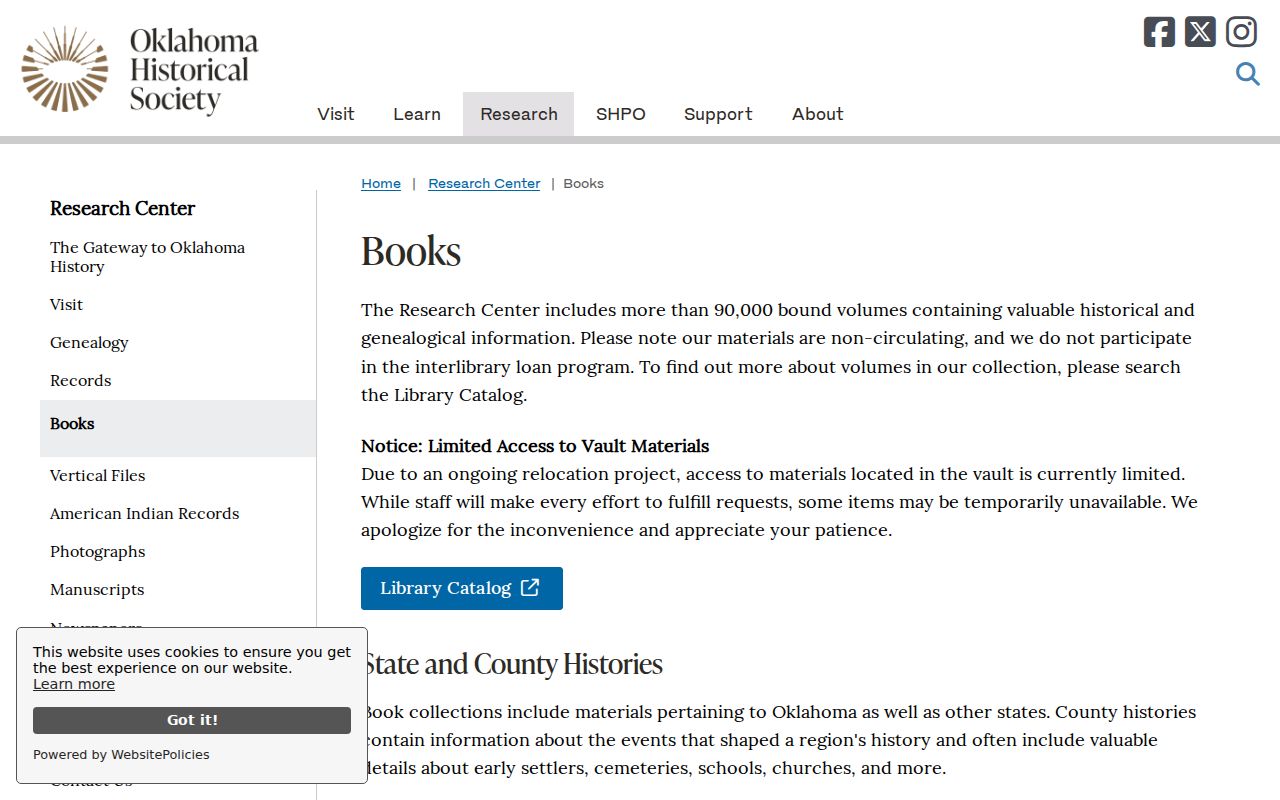
The catalog categories help separate a directory result from a yearbook or newspaper clue, which reduces the risk of assigning an undated name to the wrong Shawnee household.
Shawnee City Directory Years at OHS
The OHS city-directory search uses City and Year fields. It is an index to holdings, not a promise that a person-level result or page image is online. Enter Shawnee and a narrow year first. If a surname is common, record the year and catalog wording before requesting the item. That small discipline makes it easier to distinguish a Shawnee directory from a similarly titled state or regional source.
The documented Polk sequence has gaps. Treat those gaps as research questions, not dates to fill with guesses. Search the years immediately before and after a move, and include the classified section when a family connection may appear through a listed service or organization. The 1901 Star volume is especially useful as an early lead, but its cited classified page must be viewed before any entry is reported as verified.
The search interface in the image comes from the OHS directory-results source and shows why collection lookup comes before an entry-level conclusion.
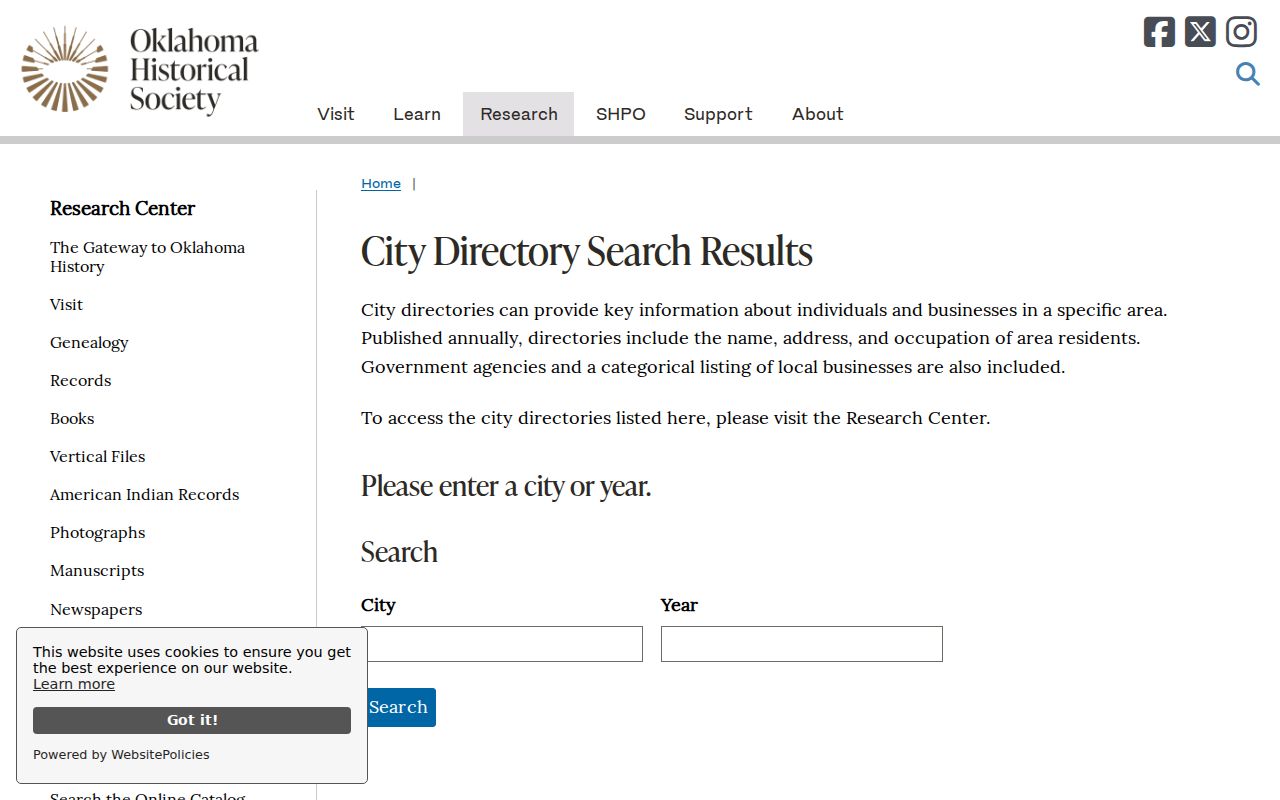
Once a holding is identified, a staff-assisted or in-person check can establish whether a scan, microfilm copy, or physical volume supplies the entry needed for a Shawnee city directory search.
Note: A directory date belongs to the source itself, so retain it even when a later record gives the same address.
Shawnee Research Desks for City Directories
When an online catalog stops at a title, Shawnee has practical in-person fallbacks. Pioneer Library System lists Shawnee Public Library as a microfilm location, with service available first-come or by arrangement with a librarian. The library is at 101 N Philadelphia Ave. and lists hours of Monday through Thursday 9 a.m. to 9 p.m., Friday 9 a.m. to 6 p.m., Saturday 9 a.m. to 5 p.m., and Sunday 1 p.m. to 5 p.m. Bring the surname, approximate year, and variant street spelling.
The library microfilm service is shown below. It offers a local route for a dated obituary, social column, public notice, or newspaper advertisement when an online search does not surface a usable name match.
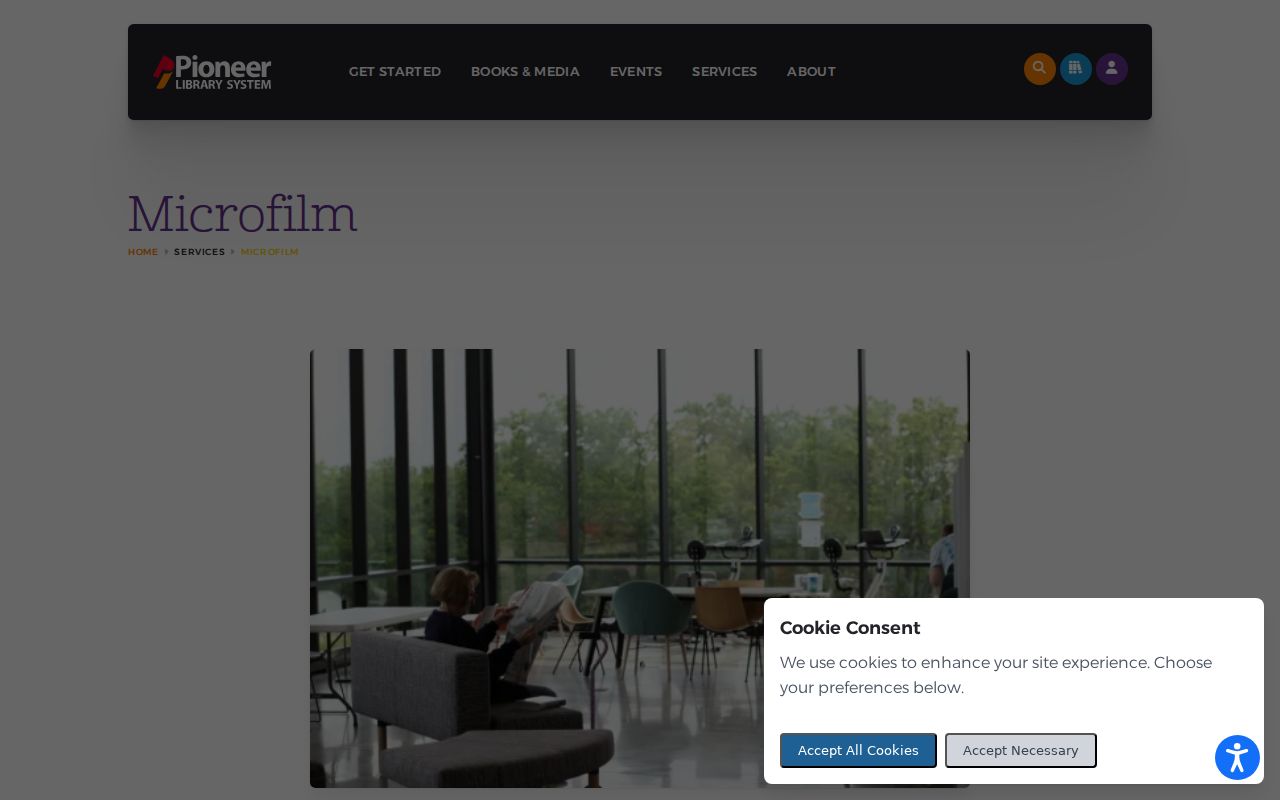
Microfilm is a companion source, not a substitute for the directory volume, because OCR can misread surnames and street numbers.
The Pottawatomie County Historical Society and Museum, at 207 N Minnesota Ave., is another local history channel. It lists Tuesday through Saturday hours of 10 a.m. to 4 p.m., with Sunday, Monday, and holiday closures. Its public history and artifacts can add context to a railroad block, family collection, or local obituary lead. Confirm access to manuscript and donor-restricted material before visiting.
Railroad-Era Shawnee Directory Leads
Shawnee's record trail reflects a rapid change in the town and county. The Oklahoma Historical Society records a land run on September 22, 1891, arrival of the Choctaw Oklahoma and Gulf Railroad on July 4, 1895, and divisional shops in 1896. The museum dates the Santa Fe Depot to 1903-04. Those dates make useful search boundaries for directory entries, plats, newspaper notices, and business listings near the depot, shops, tracks, and commercial blocks.
Use the source's own place label. A historical reference may say Shawnee Agency, Pottawatomi, Pottawatomie County, Town of Shawnee, or a railroad district. They do not all mean the same jurisdiction. Search both Pottawatomie and the historical Pottawatomi spelling when the record itself uses it, and preserve that spelling in notes.
- Choose a directory year close to the date being investigated.
- Search the surname, a variant spelling, and any railroad or depot term found in a newspaper notice.
- Write down the directory address separately from the modern address form.
- Compare the result with a plat, deed, or dated newspaper page before placing it on a current map.
Note: Railroad and depot references can explain local context, but a directory or primary record is still needed to connect a named person to an address.
Reading Shawnee City Directory Entries
A scanned Shawnee directory page was not captured during the research, so its exact field order and abbreviation key must be checked in the volume itself. Use a careful inventory instead of assuming every directory uses the same marks. A useful entry may contain a surname and given name, a spouse in parentheses, an occupation or organization, a street address, and a status mark. The mark is only meaningful after its local abbreviation key has been read.
| Name | Record the spelling exactly, then note any surname variant used for follow-up searching. |
|---|---|
| Address | Keep the printed house number and street wording. It is a historical address, not a current residence claim. |
| Spouse or household cue | Parentheses or widow notation can be a family-history lead, but must be checked against the directory key and a second record. |
| Occupation or organization | Use it to distinguish same-name people, then verify the connection in a dated source. |
| Status mark | Do not infer a meaning until the volume's own abbreviation key confirms it. |
- Criss-cross directory
- A directory arranged by street and number rather than surname. The research calls it a useful address-to-name lead when a volume includes one.
- Householder index
- An index organized around a household or address. Its scope varies by volume and needs confirmation from that book.
- Abbreviation key
- The publisher's explanation of short marks and labels. Photograph or transcribe it with the entry so later notes remain accurate.
Shawnee News-Star Beside Directory Results
The OHS Gateway Shawnee News-Star collection adds dated context after a directory search. The title is listed as 1943-current, and the visible digitized run captured for research spans 1957 through 1962. The collection displayed 1,095 issues and 18,635 pages at that time. Digitization changes over time, so capture the issue date, page, and OCR term used rather than treating those counts as permanent coverage.
Use the issue viewer for obituaries, social columns, elections, public notices, and advertisements. Compare every OCR hit to the image. Names with initials, hyphens, and common spellings are prone to error. A January 16, 1957 sample issue is identified as a 12-page microfilm issue from Shawnee News Co., which demonstrates the kind of date and publication information that should stay with a newspaper citation.
Newspaper text can explain why a household vanishes from a directory, but it should not convert an old address into a present-day one. A property question belongs in the Shawnee street directory workflow, which uses the county's address-keyed sources.
Shawnee City Directory Family Context
OHS also provides an American Indian Census search for Shawnee Agency and Potawatomi-area census, payment, birth, death, and marriage materials. The FamilySearch catalog describes the Shawnee, Potawatomi, and Kickapoo Agency context, including records from the 1830s through 1929 with some mid-1930s material. These collections can help establish a family relationship or community connection that a city directory does not show.
Keep each source in context. Agency residence, enrollment, payment-roll appearance, and citizenship are different facts. They must not be reduced to a general claim that a person lived in Shawnee. Record the agency label, date, roll type, and relationship field exactly as presented, then compare it to local directory or newspaper evidence.
The museum's public history offers another path for local context. Its historical society was founded in 1926, the museum opened in 1982, and its county history book was published in 1987. Those dates can guide questions about anniversary materials, photographs, or county-history references without assuming that any private membership list is open.
The Pottawatomie County Historical Society and Museum source shows the public entry point for this work and its visitor details.
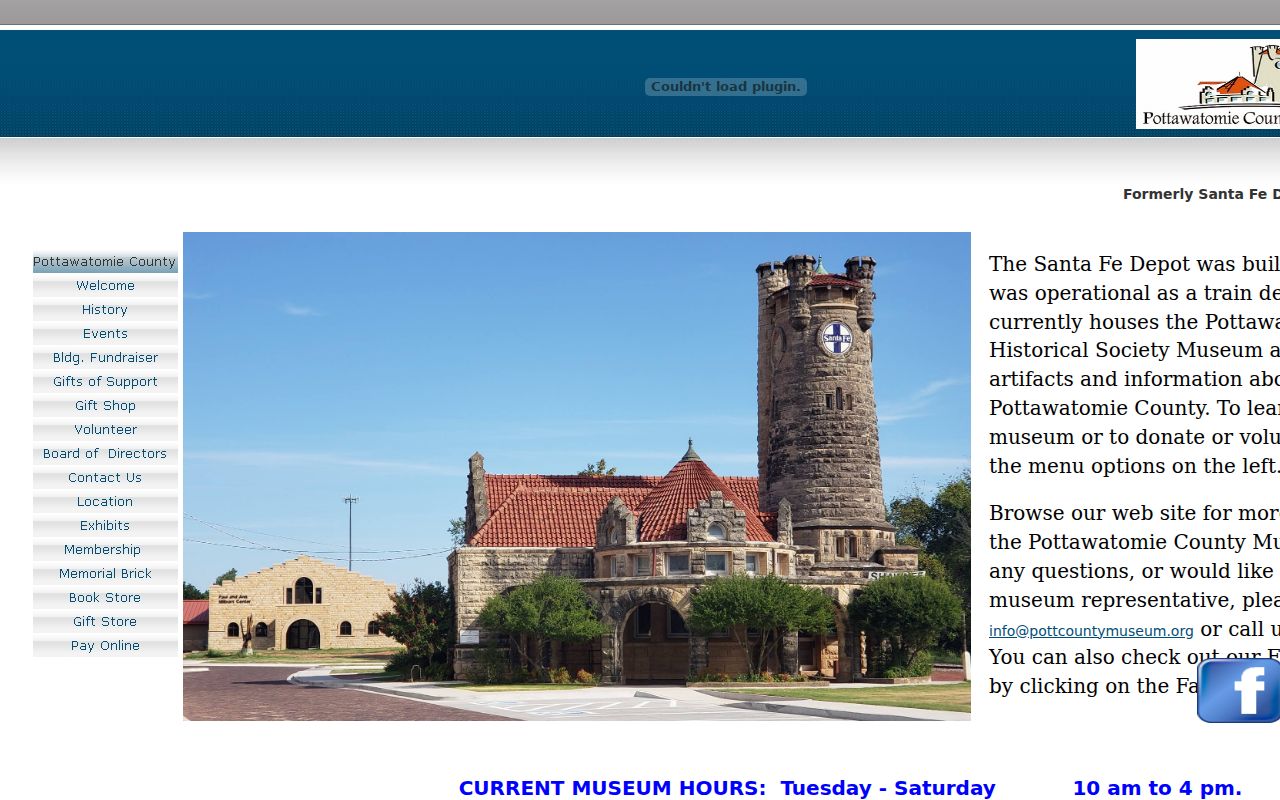
The museum gives a local fallback when a catalog search needs county context, while the directory volume remains the source for the actual printed listing.
Trace a Shawnee City Directory Household
Trace a household through date-matched records rather than building a story from one entry. Start with the first known address, then check the same person and street in the next available Shawnee directory. Write moves, spelling changes, household changes, and disappearance as separate observations. The federal census offers a household snapshot on its enumeration date, while a directory may have been compiled months before it was printed.
- Find the person or address in the nearest documented Shawnee city directory year.
- Search the next available volume for the same surname, address, and spelling variants.
- Keep the printed address separate from a tax mailing address or a later parcel address.
- Pair directory years with the 1910, 1920, 1930, or 1940 census when the federal 72-year release rule permits access.
- Use an obituary, probate file, or newspaper notice to investigate a sudden endpoint, not to guess its cause.
A move can look like a disappearance. A death, a new marriage, a publisher's coverage change, or simple nonlisting can look the same at first. Preserve conflicting entries with their dates and source type. That makes later verification possible and avoids forcing a convenient answer.
Shawnee City Directory Dates in Context
Shawnee became the Pottawatomie County seat through the December 19, 1930 election, and the New Deal courthouse opened on July 6, 1935. Those civic changes help explain why a historical search may lead to city, county, territorial, or state repositories. The county clerk reports recording history reaching the late 1800s, but its online land-record index starts in January 1985. A missing online deed is therefore a portal limit, not a conclusion about an older address.
| 1891 | Land run documented by the Oklahoma Historical Society. |
|---|---|
| 1895-1896 | Choctaw railroad arrival and divisional shops create useful newspaper and directory search terms. |
| 1901 | Star Directory Company Shawnee volume is a documented bibliographic lead. |
| 1930-1935 | County-seat transition and courthouse opening can narrow searches for county records and public notices. |
| 1985 | Verified start of the Pottawatomie online land-record index and images. |
Note: Older records can be distributed among the Clerk, OHS, library, and historical collections, so include the record date when asking a Shawnee custodian for help.